
Letting the Work Arrive
circling the want
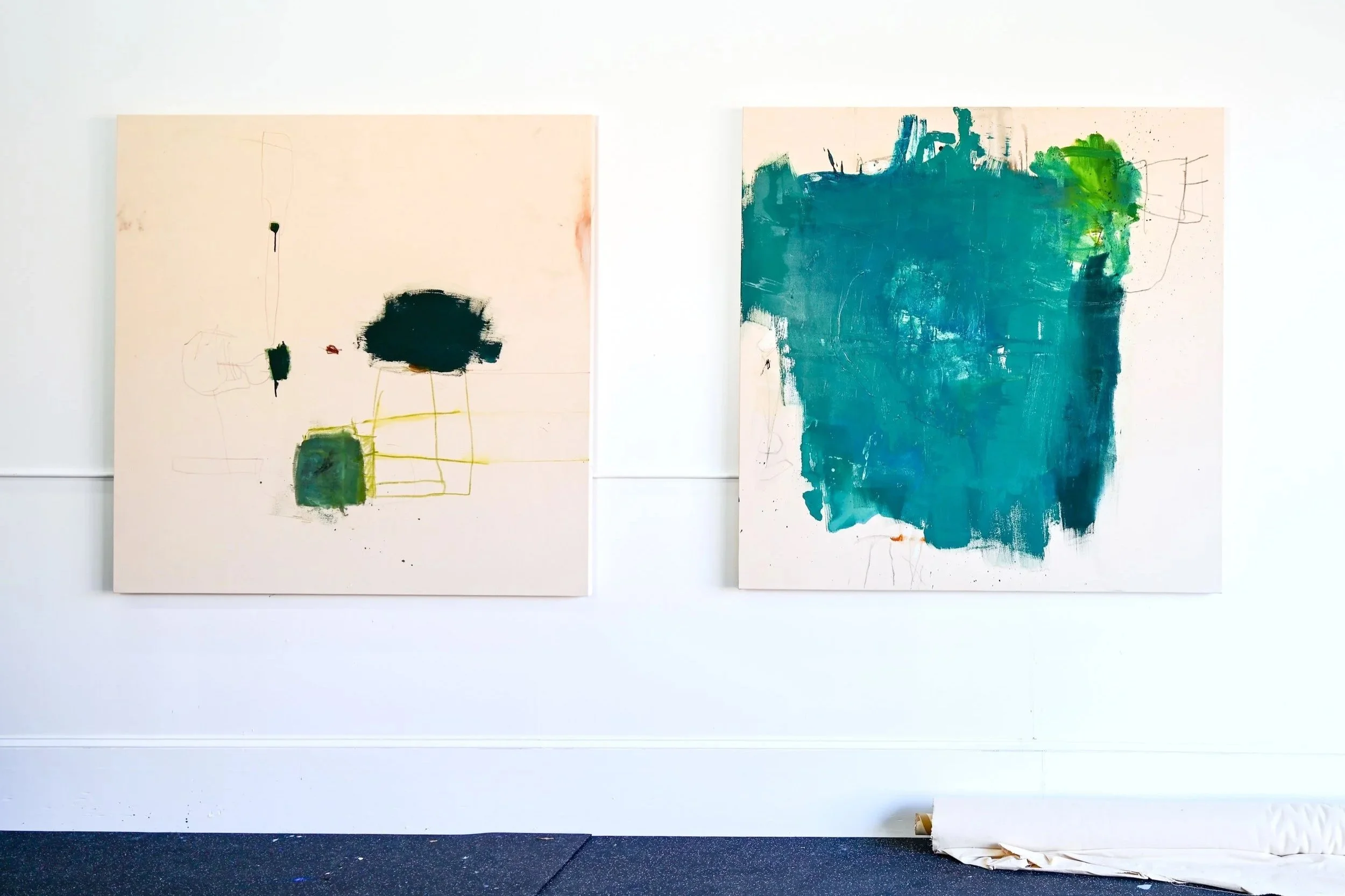
For a long time, I’ve been circling around the idea of large paint expanses. Wanting them. Reaching for them. Trying, over and over, to make them happen.
And every time I try, the work pushes back.
When I attempt to force a large field of paint, it shows up as control. The shapes feel planned, managed, slightly contrived. They lose the looseness I trust. I can feel the effort in my body and see it on the canvas. Wanting something, I’ve learned, is very different from letting it arrive.
a quiet question and answer
This new year, and this new studio, has been asking me to work differently. To notice what changes when the space changes. Instead of pushing for an answer to get my outcome which I have done so many times, I asked a quieter question. Not one meant to be solved, but one meant to be held in its own space:
What is the best way for large paint expanses to enter my work?
Then I let that sit versus trying to think of an answer. I left room. And that space mattered because two unexpected things happened almost immediately.
First, I noticed one of my favorite artists, Gordon Studer, using masking fluid which is something integral to his process. Watching him work, it suddenly clicked that interruption could be a doorway for me; that breaking the surface in an organic way might allow the larger spaces to feel intuitive instead of imposed.
Then another thought arrived: acrylic soft gel gloss. I imagined applying it thickly, letting it dry, and creating a slick surface—one that resisted my usual brush drag. Normally, the friction of the canvas forces my hand into a slow controlled pace with large gestures. What if the surface refused that control? What if the paint had room to move however it wanted to much the way I usually work in smaller areas?
the shift
What struck me wasn’t just the ideas themselves—it was how they arrived.
I asked a question and didn’t crowd it. And the answer came as an invitation to change the process rather than the outcome. To approach the same desire from a different direction. Wow, how did this lightbulb take so long to turn on?
This is where intuition always meets me: when I stop insisting and start listening, I’m no longer in the dark.
Wanting something is very different from letting it arrive.
and then balance
My work is often described as minimal, and large paint expanses might seem like the opposite. More. Fuller. Almost maximal. But my intuition doesn’t register that distinction. Seventy percent negative space and seventy percent painted space speak the same language to it. What matters is whether the work feels alive—whether I want to stay with it instead of painting it over and beginning again—that’s the intuition.
Interestingly enough, the contrast itself is a form of balance that feels grounded - there is no need to be forcing sameness. Canvases can hold different ratios of quiet and fullness and still belong to the same conversation. They don’t compete. They offer each other rest simply because I created them from my intuition, not my thinking brain.
letting it arrive
And maybe that’s the larger lesson here—one that reaches beyond the studio.
What can change when we stop trying to force the shape of something we want, and instead ask how it that thing wants to arrive? How can we allow and enable this quieter part of ourselves to take over?
For me, when I give my intuition room, it doesn’t just respond—it expands—and that is everything in my work!
~
Spring is officially here in SWFL. It feels fresh and warm here. I’ve been very busy in the studio and working with the wonderful galleries that represent me (Huff Harrington & Gardner Colby), and if you are in the surrounding Naples, Florida area, come by Gardner Colby for their Spring Fling show featuring five of their great local artists, including me, on March 4th.
In the meanwhile, I know Sam and I will see you outside…and of course, always at the beach hunting for sand dollars….
XO, Chris
